U.S. Census data and surveys, the rarest interracial couples are those pairing Black women with Asian men (approx. 0.2% of married Black women) and black women with white men (3% of all intermarried couples), along with specific, localized pairings like Black men/Indian women. These pairings are influenced by cultural, social, and demographic factors, such as population size and community insularity.
Rarest Pairings and Trends
Black Woman/Asian Man: Cited in Wikipedia as the least prevalent, with only 0.2% of married Black women in this pairing in the U.S..
Black Woman/White Man: While Black man/White woman pairings are more visible, this combination is significantly less common, forming just 3% of all intermarried couples
.
Asian Man/White Woman: Only 29% of all Asian/White marriages involve an Asian American male and a White female, indicating this is rarer than the inverse.
Black Man/Indian Woman: Often described on forums as highly rare, with observers noting insular community dynamics in certain areas.
Factors Influencing Rarity
Demographics: Low numbers of specific groups in a region reduce the probability of pairings.
Cultural Insularity: Some communities have strong traditions of marrying within their ethnicity.
Gendered Patterns: Intermarriage rates differ drastically by gender within the same racial group (e.g., Black male-White female vs. Black female-White male).
Note: The perception of "rarity" can vary by region; some pairings described as rare nationally might be more common in highly diverse urban centers.
Intermarriage varies by race and ethnicity
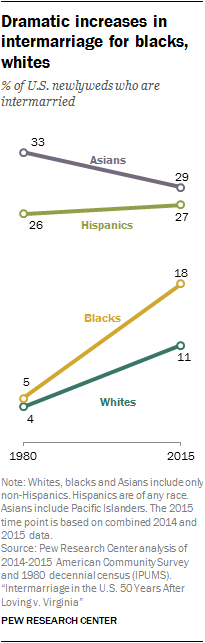
Overall increases in intermarriage have been fueled in part by rising intermarriage rates among black newlyweds and among white newlyweds. The share of recently married blacks with a spouse of a different race or ethnicity has more than tripled, from 5% in 1980 to 18% in 2015. Among recently married whites, rates have more than doubled, from 4% up to 11%.
At the same time, intermarriage has ticked down among recently married Asians and remained more or less stable among Hispanic newlyweds. Even though intermarriage has not been increasing for these two groups, they remain far more likely than black or white newlyweds to marry someone of a different race or ethnicity. About three-in-ten Asian newlyweds (29%) have a spouse of a different race or ethnicity. The same is true of 27% of Hispanics.
For newly married Hispanics and Asians, the likelihood of intermarriage is closely related to whether they were born in the U.S. or abroad. Among the half of Hispanic newlyweds who are immigrants, 15% married a non-Hispanic. In comparison, 39% of the U.S. born did so. The pattern is similar among Asian newlyweds, three-fourths of whom are immigrants. While 24% of foreign-born Asian newlyweds have a spouse of a different race or ethnicity, this share rises to 46% among the U.S. born.
The changing racial and ethnic profile of U.S. newlyweds is linked to growth in intermarriage
Roughly 29% of Asian newlyweds have a spouse of a different race. Asian women are far more likely to marry outside their race (36% in 2015) than Asian men (21% in 2015).
Hispanics: Roughly 27% of Hispanic newlyweds marry outside their race/ethnicity, with those born in the U.S. being significantly more likely to intermarry (39%) than immigrant Hispanics (15%).
Blacks: Intermarriage rates have increased, with about 24% of newlywed black men marrying outside their race compared to 12% of newlywed black women.
Whites: Have lower rates of intermarriage (around 11%), but because they make up the majority of the population, they are often part of the most common interracial pairings.
Key Factors and Trends
Gender Gaps: There are large gender differences in intermarriage for Asians (women more likely) and blacks (men more likely).
Education: Higher levels of education are associated with a greater likelihood of interracial marriage.
Geography: People living in the Western U.S., particularly in cities like Honolulu and Las Vegas, are more likely to intermarry than those in the South.
Catholics Hear Mass in English Today for First Time in the U.S. https://www.nytimes.com/1964/08/24/archives/catholics-hear-mass-in-english-today-for-first-time-in-the-us.html?smid=tw-share

Comments
Post a Comment